India's Four Labour Codes Explained: What Changed for HR, Attendance and Payroll (2027 Guide)
Legal disclaimer: This publication contains general information which is intended to be of assistance to HR managers, employers and employees, but is not legal advice. Labour requirements may vary from establishment to establishment, industry to industry, and based on worker classification, State and the appropriate government. For compliance purposes, check the current Central or State notification.
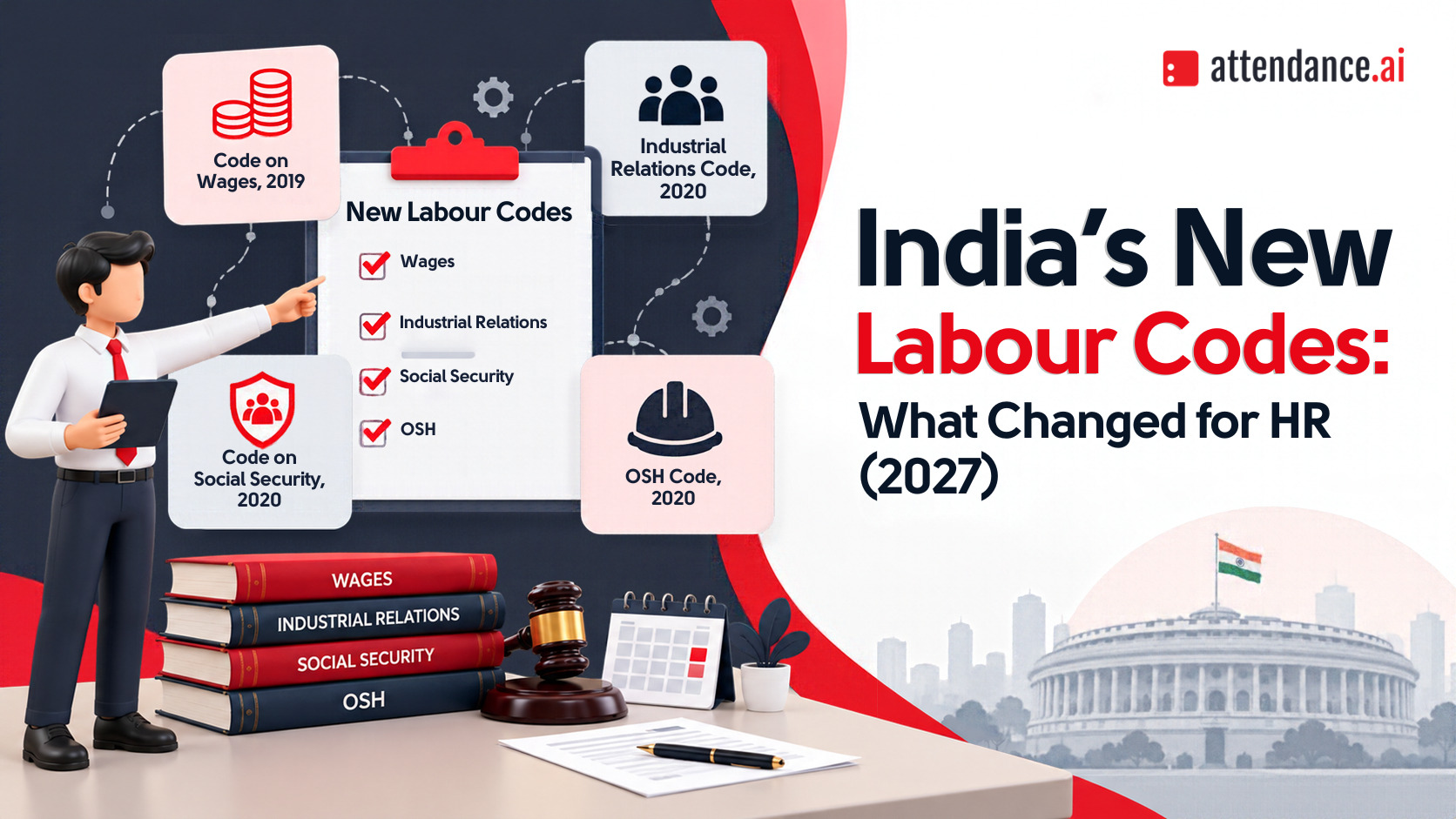
The new labour code model has compelled the employers to re-calibrate the way wages, hours of work, overtime, attendance, leave and record of employment are to be managed. There are four Labour Codes that combine 29 central labour laws. These four Codes are – Wages; Industrial relations; Social security; and Occupational safety, health and working conditions.
While the four Codes are relevant to HR teams, the more relevant concern for them is not just remembering the name of the 4 Codes. The real-life challenge is ensuring that the employee database, record of attendance, actual working hours, overtime, leave, wages, etc, are correctly documented according to the relevant rules for an establishment.
The four codes in one table and what they replaced
The four Labour Codes merge 29 Central labour legislation into four comprehensive systems. – Labour Code on wages, minimum wages, payment of wages and bonus. – Industrial relations code on trade unions and industrial disputes. – Social Security code on social security benefits. – OSH code on safety, working conditions, hours of work and other employment-related requirements.
|
Labour Code |
Main area |
Major laws consolidated |
|
Code on Wages, 2019 |
Wages, minimum wages, payment of wages and bonus |
Payment of Wages Act, Minimum Wages Act, Payment of Bonus Act and Equal Remuneration Act |
|
Industrial Relations Code, 2020 |
Industrial relations, trade unions and disputes |
Trade Unions Act, Industrial Employment Standing Orders Act and Industrial Disputes Act |
|
Code on Social Security, 2020 |
EPF, ESI, gratuity, maternity and social security |
EPF Act, ESI Act, Payment of Gratuity Act, Maternity Benefit Act and other laws |
|
OSH Code, 2020 |
Safety, health, working conditions, hours and leave |
Factories Act, Mines Act, Contract Labour Act and other laws |
The four major codes are the Code on Wages, 2019, the Industrial Relations Code, 2020, the Code on Social Security, 2020, and the Occupational Safety, Health and Working Conditions Code, 2020.
For HR, this consolidation means that compliance can be managed as a single, integrated process. Attendance affects time recording, time recording affects overtime, and overtime affects wages. Staff records also support several statutory responsibilities.
Timeline: In Force 21 Nov 2025, Central Rules May 2026, State Rules Pending
The four Codes of Labour came into effect on 21 November 2025. The Central Government issued the Central Rules in May 2026. But implementation at the State-level shouldn't be taken as identical all across India. Employers should verify the rules and notifications applicable to their establishment, and their appropriate government, rather than assume their one checklist which applies to all.
The Ministry of Labour and Employment issued notification for its enforcement of the four Codes on 21 November 2025. The Central Rules were notified in May 2026. The Code on Wages (Central) Rules, 2026 and OSH and Working Conditions (Central) Rules, 2026 contain their respective commencement provisions.
The statement that all State rules are simply pending are a bit too wide. State and Central jurisdiction can be different, also how each one is to be implemented differs from establishment to establishment.
HR should monitor the official Ministry of Labour and Employment labour codes portal for notices, rules, FAQs and implementation updates.
This is of particular concern to organisations with operations in multiple States. Even where there is only one HR policy across a business, a requirement that differs in a State must be checked.
Working hours, overtime and weekly rest
The OSH Code is the primary source for regulating hours of work, overtime and weekly rest. Provision has been made under Section 25 for daily and weekly hours of work, under Section 26 weekly and compensatory holidays and under Section 27 two times overtime wages and wages of public holidays.
The Code sets eight hours as the relevant daily working-hour minimum. According to the Ministry's Labour Code FAQ, overtime wages must be paid at twice the applicable rate, if a worker exceeds the relevant prescribed working hours.
This is central to understanding working hours as per labour law in India. Employers should not assume that changing the length of a daily shift automatically removes overtime obligations. The applicable provisions and rules must be considered together.
Section 27 of the OSH Code deals with overtime wages. The Ministry's FAQ also explains that employees covered by the relevant provisions can be eligible for overtime when they work beyond prescribed hours.
So, overtime rules in India should be considered in conjunction with attendance rules. HR must be aware of the time an employee clocked in and out, whether breaks were deducted appropriately, if overtime was approved and the manner in which overtime pay was calculated.
Weekly rest is also relevant. Section 26 sets the legal basis for weekly and compensatory holidays. So, attendance should be recorded not just as to the fact of attendance.
Records and registers, including electronic registers
The compliance of the Labour Acts is the need for record. As per Rules Code on Wages (Central) 2026, the following registers are essential to be maintained- employee register, an attendance-cum-muster roll, an employee register and records of wages and overtime. These registers should be maintained electronically or otherwise.
This is why muster rolls are so important to HR departments. The muster roll should have the information required by the rules that apply to it and should be consistent with the attendance and payroll of the persons concerned.
Rule 53 of the Code on Wages (Central) Rules, 2026 provides for specified registers including the employee register, attendance-cum-muster roll, wage and overtime records and other prescribed records. These registers may be maintained electronically or otherwise.
The rule also requires records to be complete and up to date and provides for production of records when demanded by the Inspector-cum-Facilitator or an authorised person. Specified records and registers are required to be preserved for the prescribed period.
For HR, a spreadsheet of missing or inconsistent attendance data is not a better compliance system just because it is in a digital format.
An effective system should allow us to identify the employee, attendance date, working hours, overtime and approvals if any. It should also allow easy retrieval of records as and when required.
Fixed-term employment, gratuity and leave
The Labour Codes set out important rules around: fixed-term employment, gratuity and leave; fixed-term employment in the IR Code; gratuity in the Social Security Code, and annual leave with wages in the OSH Code (based on the existing eligibility requirements).
Section 2(o) of the IRC, 2020 as being employment under a contract of employment for a fixed period of time, provided that the benefits or conditions of employment shall not, in the meantime, be less favourable than those of a permanent worker of the same or similar employment.
The gratuity scheme is set out in the Social Security Code and fixed-term employees are dealt with specifically in regard to the gratuity scheme, subject to certain statutory requirements.
Annual leave with wages is dealt with under Section 32 of the OSH Code. The Code provides eligibility requirements based on days worked and establishes the statutory framework for annual leave.
Leave is not a one size fits all stand-alone formula for all employees at all establishments. Rules, category of establishment and the State requirements are check before a policy on leave can be finilised.
You should make sure that you also compare employment contracts, attendance records and leave records. If these records vary in any way, this could raise some questions in the event of an audit or an employee dispute.
Who is covered, thresholds and exemptions
The number of employees to include under the four Labour Codes is based on the relevant definition, type of establishment, worker/employee definition, threshold and government concerned. There is no set employee count threshold for applying each of the Labour Code obligations. HR must always check the specific regulation and parameters to determine if an obligation applies.
The OSH Code has some regulations on establishments, workers, registration, welfare amenities and different sorts of work. The Central Rules set the process for registration and what info could also be uploaded electronically through the applicable government portal.
Thresholds may be relevant in relation to specific welfare or statutory requirements: the precise provision and specification will depend upon the provision and specification.
For this reason it is relevant to an HR compliance matrix. Rather than writing "Labour Code applies" or "Labour Code does not apply", HR would write the Code, section, rule, employee category, threshold and jurisdiction.
Similarly exemptions should be checked directly with the legislation, rules or notification. It is always unwise for a company to assume that an exemption is applicable just because another organisation within the same industry uses it.
Compliance checklist for HR by month
A practical compliance process should be reviewed every month rather than only when an inspection, audit or employee dispute occurs. A good labour law compliance checklist India should connect employee records, attendance, working hours, overtime, leave, wages and statutory registers.
Every month, HR should:
1. Verify employee master data and employment status.
2. Check attendance records for missing or unusual entries.
3. Review daily and weekly working hours.
4. Reconcile overtime hours with payroll.
5. Check overtime calculations and approvals.
6. Review leave applications and balances.
7. Update employee and wage registers.
8. Verify required attendance records.
9. Check wage deductions and payments.
10. Ensure electronic records are complete and retrievable.
Every quarter, HR should:
- Review Central and State labour notifications.
- Check employee classifications.
- Review fixed-term employment contracts.
- Audit overtime trends.
- Verify applicable thresholds.
- Test whether statutory registers can be produced quickly.
- Check whether payroll and attendance records agree.
Annually, HR should compare policies, templates, registers, employment contracts and compliance procedures to the latest legislation and notifications.
This is not about more paperwork. It is about ensuring what HR and payroll already generate can underpin statutory records.
How attendance software supports compliance
Labour Code compliance With attendance software, you can have all your attendance, working hours, overtime, leave records in one place. Software is not enough. HR needs to ensure that the system is configured based on the right Code, notifications, rules and State.
The greatest advantage is the elimination of manual errors. A system that is well setup can track attendance, calculate hours worked, as well as overtime, keep a record of leave, and assist in reconciling attendance to payroll.
This is especially so where the regulations of the Code on Wages (Central) Rules, 2026 allow for certain registers to be maintained electronically and specify attendance-cum-muster rolls and wage and overtime registers as prescribed records.
The attendance register format which an organisation should use may differ in that the information which it requires to establish the organisation in the register should be the same as to be consistent with payroll and other HR records.
The biggest risk to any organisation still using multiple spreadsheets for attendance, overtime and leave is inconsistencies. A member of staff may be on a different number of hours on their attendance sheet than in the payroll. Moving everything into one place closes that gap.
To enable attendance automation, registers and labour-code readiness, attendance.ai can be used for compliance workflows, attendance records and everything connected to HR processes.
Final takeaway
A shift from labour laws to labour code Did you know? The new labour code framework in India is not merely a nomenclature change of labour law. It has also brought with it new rules on employees' wages, attendance, working hours, overtime, leave, registers.
It's logical for HR to take the four Codes first, then search for precisely which parts, and sections, and rules in them are actually relevant to the particular site and work from there, developing procedures based on full and correct records.
The Code on Wages 2019 and OSH Code 2020 text in this presentation shall be followed as the principal legal reference sources as well as ministries of labour and employment notifications, questions and answers and labour code portal.
The best course of compliance is simple, keeping good records; check the law of the relevant jurisdiction; examine the State's requirements; and always do not rely on the unverified labour-law summary to make a decision about employment.
FAQ’s
1. What are the four new labour codes in India?
India's four new Labour Codes are the Code on Wages, 2019, the Industrial Relations Code, 2020, the Code on Social Security, 2020, and the Occupational Safety, Health and Working Conditions Code, 2020. They consolidate 29 Central labour laws covering wages, industrial relations, social security, workplace safety and working conditions.
2. What are the working hours as per labour law in India?
The OSH Code, 2020 provides the framework for daily and weekly working hours. The prescribed standard is eight hours a day, with overtime provisions applying when workers exceed the relevant limits. Employers should check applicable rules, shift arrangements and State-specific requirements to determine their obligations.
3. What are the overtime rules in India under the new Labour Codes?
Section 27 of the OSH Code, 2020 provides for overtime wages at twice the normal rate when a covered worker works beyond the applicable prescribed working hours. Employers should maintain accurate attendance records, verify overtime eligibility and calculate payments according to the applicable rules.
4. What is the difference between a muster roll and an attendance register?
A muster roll records worker attendance and related employment information required under applicable rules. An attendance register records employees' daily attendance and may include working hours, check-in and check-out times, and absences. Employers should ensure their records meet the requirements applicable to their establishment and remain consistent with payroll data.
5. How can HR maintain compliance with India's new Labour Codes?
HR teams can maintain compliance by reviewing working hours, overtime, wages, leave, employee classifications and statutory registers regularly. They should follow a labour law compliance checklist, monitor notifications from the Ministry of Labour and Employment, and maintain accurate electronic or physical records. Attendance software can help organise records and reduce manual errors.