Muster Roll: Format, Meaning, Who Must Maintain It and Penalties (New Labour Codes)
Ask three HR teams what a muster roll is and you'll hear three answers. One says it's the attendance sheet. Another says it's the wage register. A third says it went away with the old labour laws. None of them is quite right.
This guide explains the muster roll in plain words. You'll see how it differs from the attendance register and the wage register, a format you can copy, and what the new labour codes changed. We also cover contract workers, digital records, penalties and a checklist for inspections. It's written for HR managers, business owners and employees in India, and it's useful for contractors and small factories too. State rules may differ from the central ones, so check yours.
Muster roll meaning in simple words
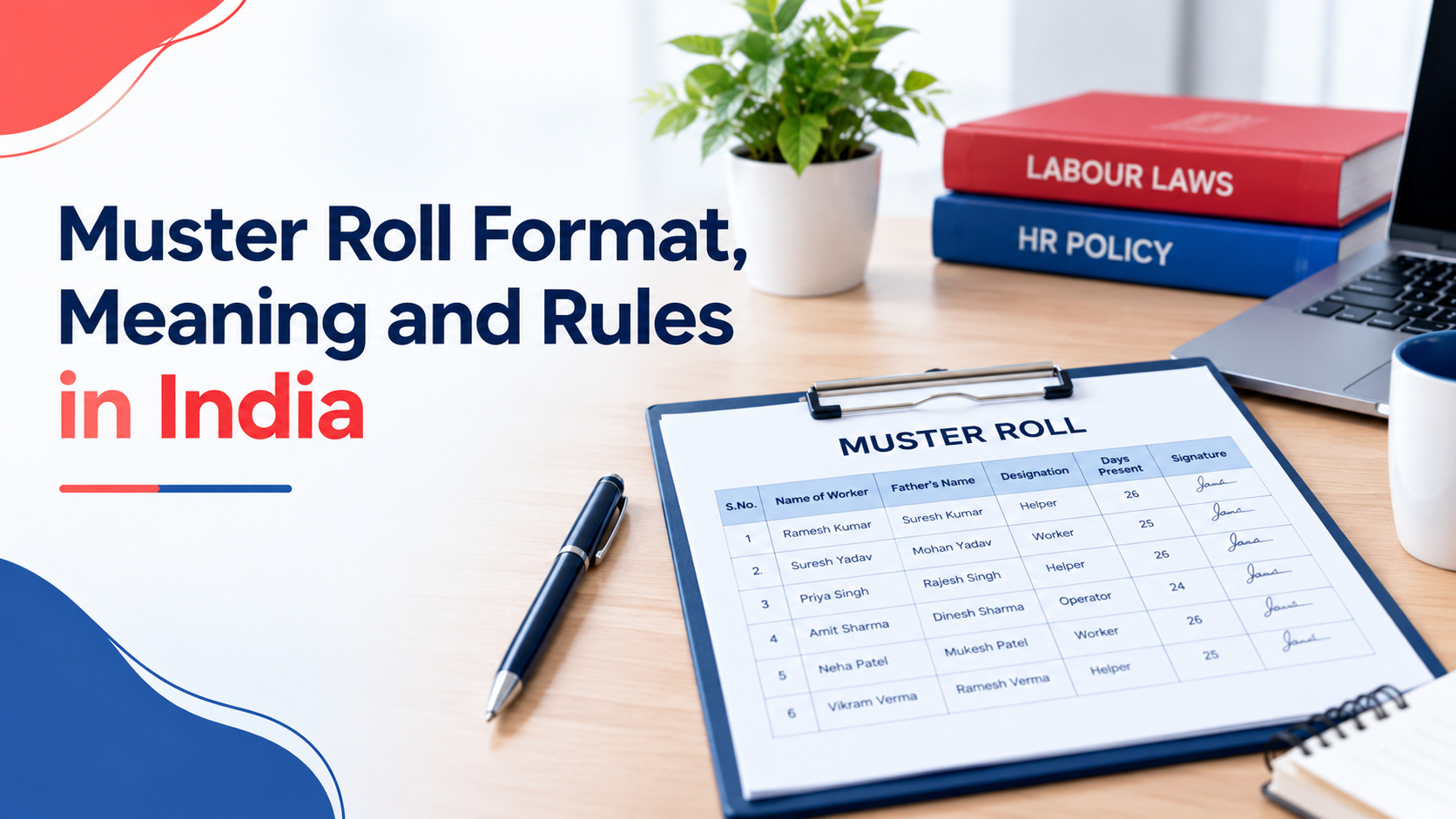
A muster roll is the official record of who worked in your establishment, on which days and for how long. Under the new labour codes, it's combined with the attendance register into one document. It's the record that proves attendance, overtime and wages when a worker, an auditor or an inspector asks.
Think of it as a monthly sheet with one line per worker. Each line shows the days they came, the days they didn't, any leave or weekly off, and their overtime.
Why does it matter? Because wages are worked out from it. If a worker says they weren't paid for 24 days and the muster roll says 26, the muster roll settles the argument. A missing or sloppy one settles it against you.
Muster roll vs attendance register vs wage register
The attendance register shows who came. The muster roll shows who worked and for how many days. The wage register shows what they were paid. Under the new central rules, the first two are now one combined form, and the wage register stays separate.
Here's how the three fit together:
- Attendance register. Daily presence, absence and leave.
- Muster roll. The monthly summary of days worked, built from that daily record.
- Wage register. Wages, overtime, advances, fines and deductions, paid against the days on the muster roll.
Before the codes, many businesses kept the first two separately. Now the Code on Wages (Central) Rules 2026 ask for one combined attendance register-cum-muster roll in Form IX, an employee register in Form I, and a wages and overtime register in Form IV. If you've read our guide on the attendance register format, you've already seen the combined form.
Muster roll format you can download
You can download a ready muster roll in Excel, PDF and Word, plus an editable Google Sheet. All four carry the same fields. The template here covers the daily attendance, shift, place of work and overtime that the combined form records, but it isn't the official form, so check the gazetted one.
All four files are free, with no email form and nothing locked. Change the codes to match your leave policy if you need to.
MUSTER ROLL (ATTENDANCE REGISTER CUM MUSTER ROLL)
Name of establishment: ____________
Place of work: ____________
Month and year: ____________
FOR EACH WORKER (one block per person)
Emp ID: ______
Name: ____________
Designation or category: ____________
Shift: ______
Daily marks, day 1 to day 31: ______________________________
Days worked: ____
Weekly offs (WO): ____
Public holidays (PH): ____
Paid leave (PL): ____
Days absent: ____
Overtime hours: ____
Remarks: ____________
Worker or supervisor sign: ____________
CODES
P = Present, A = Absent, HD = Half day, WO = Weekly off,
PH = Public holiday, PL = Paid leave
Prepared by: ____________
Checked by: ____________
Date: ____________
A variation for contract workers. If you're a contractor, or you're a principal employer keeping a copy, add the details that tie each worker to the contract.
MUSTER ROLL: CONTRACT WORKERS
Name of principal employer: ____________
Place of work (site): ____________
Name of contractor: ____________
Contractor licence number: ____________
Nature of work: ____________
Month and year: ____________
FOR EACH WORKER
Worker ID: ______
Name: ____________
Skill category: ____________
Daily marks, day 1 to day 31: ______________________________
Days worked: ____
Overtime hours: ____
Contractor sign: ____________
Principal employer check (initials and date): ____________
Factories can also look at our guide on attendance software for manufacturing for shift-heavy sites.
What the new labour codes changed about records
The new labour codes merged the muster roll and attendance register into one combined record. The Code on Wages (Central) Rules 2026 call it Form IX, and the OSH Central Rules 2026 call it Form XIV. Both allow paper or electronic records, and both ask you to keep them for five years.
Here's the short version of what changed:
- One document, not two. The old muster roll and attendance register are now a single attendance register-cum-muster roll.
- Two sets of rules, two form numbers. The Code on Wages rules prescribe Form IX. Separately, rule 72 of the OSH Central Rules 2026 asks for an employee register in Form XIII, an attendance register-cum-muster roll in Form XIV, and a register of wages, overtime and deductions in Form XV. Don't assume one set of forms covers the other. Ask your adviser which apply to your establishment.
- Paper or electronic. Either is allowed.
- Five years. Keep the records for five years.
- State rules. The central rules bind establishments in the central sphere. States are still rolling out their own rules, and the forms may differ.
What about penalties? Under section 54 of the Code on Wages, an employer who doesn't maintain records, or maintains them improperly, can be fined up to Rs 10,000. Other contraventions can attract a fine of up to Rs 20,000, and paying a worker less than they're due can attract up to Rs 50,000. Many first-time offences can be settled by compounding, which means paying 50 percent of the maximum fine. The OSH Code has its own penalty provisions, so check those too.
Get the official forms from theCode on Wages (Central) Rules 2026 and theOSH Code (Central) Rules 2026, and confirm with a labour law professional which ones apply to you. For the bigger picture, our guide on the new labour codes explains all four codes.
Contract labour and muster roll for principal employers
For contract workers, the contractor keeps the muster roll and the principal employer checks it. A contractor who has employed 50 or more workers needs a licence under the OSH Code. The principal employer still carries duties for welfare facilities, and may be pulled in if the contractor defaults, so don't leave the records entirely to them.
Let's break down who does what.
The contractor keeps the muster roll, the wage register and the wage slips for their own workers. These should be maintained by the contractor, not folded into the principal employer's systems.
The principal employer is the business where the work actually happens. Under the OSH Central Rules, welfare facilities such as toilets, drinking water, first aid, a canteen and a crèche fall to the principal employer, not the contractor.
What to collect from every contractor:
- A copy of their licence and its validity date
- PF and ESI registration details
- Muster roll and attendance extracts each month
- Wage registers and proof of payment
- Appointment letters or engagement records
Keep these in one contractor file. If a worker complains about unpaid wages, you'll want to show you checked. And if you run a factory with many contractors, this is the section to take seriously.
Digital muster roll: is it accepted?
Yes. Both the Code on Wages rules and the OSH Central Rules allow these registers on paper or electronically, kept for five years. What counts is that the record is accurate, can't be changed unnoticed and can be shown on request. A spreadsheet or software is fine if it meets those tests.
Paper is fine for a very small team with no devices. Digital is usually better once you have more than about 25 people, several sites, or overtime to calculate from the record.
If you go digital, check four things:
- Edit history. Every change should show who made it and when.
- Easy retrieval. You should be able to print or export any month in minutes.
- Five-year storage. The data must stay available even if you change vendors.
- Limited editing. Not everyone should be able to change past entries.
Most trouble with digital records comes from missing backups, not from the law.
Inspection readiness checklist
Be ready to show a complete, signed muster roll for the last five years, matching wage and employee registers, and contractor records for any contract workers. Missing or improper records can attract a fine of up to Rs 10,000 under the Code on Wages, so a short monthly check is cheap insurance.
Before an inspector arrives, check that you have:
- The right form. The official Form IX, or Form XIV where the OSH rules apply to you.
- No gaps. Every worker, every day, every month, with no blank cells.
- Signatures. A supervisor's sign-off on each month.
- Matching records. Days on the muster roll should match the wage register and wage slips.
- Overtime proof. Overtime hours that tie back to the daily record.
- Contractor files. Licences, muster roll extracts and payment proofs for every contractor.
- Appointment letters. One for each worker, including contract and fixed-term staff.
- Five years of storage. Old months backed up and easy to find.
Common mistakes to avoid
- Filling it at month end. Memory isn't a record keeper. Mark it daily.
- Leaving cells blank. Use a code, even for weekly offs.
- Using different codes on different sheets. The totals stop meaning anything.
- Letting the muster roll and wage register disagree. Inspectors compare them first.
- Overwriting corrections. Strike through, write the fix and initial it.
- Skipping sign-off. An unsigned roll is easy to dispute.
- Trusting the contractor without checking. Ask for extracts every month.
- Assuming state rules match the central ones. They may not.
If you'd like records, registers and compliance handled in one place, attendance.ai offers compliance management alongside its attendance and leave features. Whether you need it yet depends on your size, and a well-kept spreadsheet is fine for a while.
Conclusion
The muster roll is a simple document that will help resolve all issues related to the number of s worked, overtime and wages paid. In accordance with new labour laws, it is combined with an attendance sheet into one document. Here are a few things you should know:
- Make sure you fill in the appropriate form, IX according to the Code on Wages and XIV according to the OSH regulations.
- Complete it daily, leaving no blank fields and getting the supervisor's signature once per month.
- Store the document for 5 years – physically or electronically.
- Ask your contractor for extracts from the muster roll every month if you work with them.
- The absence or incorrect records may lead to a fine of Rs 10,000 according to the Code on Wages. The monthly check takes much less time. You can start by using a free template below and then consult a professional in labour laws about your establishment.day
Frequently asked questions
What is a muster roll?
It is the official record of which workers worked on which days, along with leaves, weekly offs, and overtime. Wages are determined from it, hence the record resolves disputes regarding days worked.
What is the muster roll format as per new labour codes?
The Code on Wages (Central) Rules 2026 mandate Form IX to be an attendance register-cum-muster roll. The OSH Central Rules 2026 have their own muster roll in the form of Form XIV. Rules can be different in states, hence verify your state rules.
Whose responsibility is it to keep a muster roll?
Employers covered under Code on Wages or OSH Code. Muster rolls of contract workers have to be maintained by the contractor and the principal employer should inspect it regularly.
What is the punishment for not maintaining a muster roll?
According to Section 54 of the Wages Code, it is punishable to maintain incorrect records or to maintain records in the incorrect manner by paying up to Rs 10,000. There could be other penalties for other offenses and there are penalties in the OSH code too.
Is an electronic muster roll acceptable?
Yes. Central rules permit both paper and electronic registers to be maintained for five years. Make sure that the register is maintained properly and cannot be changed and is accessible whenever required.