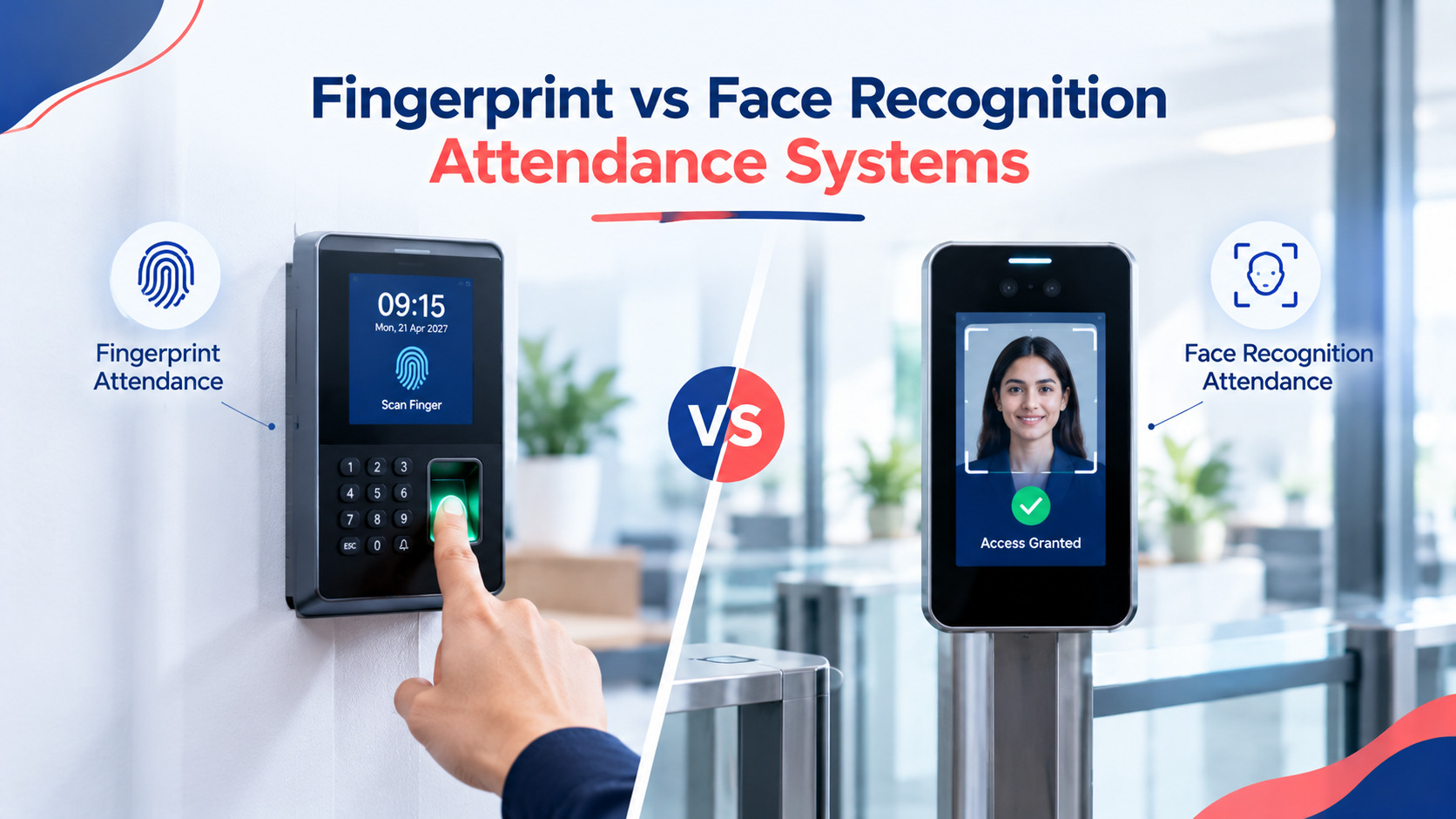
Fingerprint vs Face Recognition Attendance: Which Is Better for Your Workforce?
Two vendors show you their demos. One says fingerprint is proven, cheap and familiar. The other says face recognition is faster, touch-free and where the market is heading. Annoyingly, both are right. They’re right about different workplaces.
This guide compares the two on accuracy, hygiene, speed, three-year cost and privacy, then looks at when to run both. It’s written for HR decision-makers at small and mid-sized companies, mainly in India, for a global reader. One disclosure up front: attendance.ai publishes this article. We keep the comparison even, and we say plainly where another approach fits better.
The short answer: which one wins for which workplace
Facial recognition is more effective for busy gates and plants that require touchless time punching. Fingerprint is cost-effective for small groups who do not wear gloves and do not have masks. There is no universally applicable method; you should consider your employees and budget.
|
Fingerprint |
Face recognition |
|
|
Features |
Matches ridge patterns on a touch sensor. About 1 second to verify. Struggles with worn, wet or cut fingers and gloves. Silicone copies can fool basic units |
Matches facial geometry from a camera. Under 1 second to verify. Touch-free. Struggles with masks, glare and low light. Photos can fool basic units |
|
Pricing model |
Terminal Rs 5,000 to 15,000, plus per-user software or a licence |
Terminal Rs 8,000 to 35,000, plus per-user software or a licence |
|
Deployment |
Standalone with USB export, or cloud-connected. Not fussy about light |
Standalone or cloud-connected. Needs sensible placement and lighting. Infrared copes better with mixed light |
|
Attendance depth |
The terminal verifies the person. Shifts, leave and payroll rules come from the software |
Same split. Some terminals keep a photo log of each punch |
|
Support |
Sensor cleaning, re-enrolment of worn fingers |
Lens cleaning, lighting checks, re-enrolment after big appearance changes |
Face recognition is usually the better call when:
- Many people arrive at once. Shift changes at factories, schools and hospitals.
- Hands take a beating. Construction, farming, kitchens and cleaning wear down fingerprints.
- Touch matters. Healthcare, food and clean environments.
- Proxy punching is a known problem. You can’t lend your face, though you can’t lend your finger either.
Fingerprint is usually the better call in three situations:
- Low-cost sites. Terminals cost less, and a small team can run on one for years.
- Faces are covered. Helmets, respirators and face shields make face matching harder, while a clean bare finger still works. Test your heaviest-handed workers first, since worn fingertips are the catch.
- Dusty, dim or outdoor sites. Light trouble hits cameras first. Dust is hard on any sensor though, so wipe it and test on site.
Some teams are also simply more comfortable placing a finger than facing a lens, and that matters for adoption.
A scoring example you can redo. Weight what matters to you, score each method out of 10 and multiply. Weights add up to 100.
|
Criterion |
Weight |
Factory: fingerprint |
Factory: face |
Office: fingerprint |
Office: face |
|
Accuracy for your workforce |
25% |
5 |
8 |
8 |
8 |
|
Speed at peak |
20% |
6 |
9 |
7 |
8 |
|
Hygiene |
10% |
3 |
9 |
5 |
8 |
|
Cost |
20% |
9 |
6 |
9 |
6 |
|
Privacy comfort |
15% |
6 |
5 |
6 |
5 |
|
Spoof resistance |
10% |
6 |
8 |
6 |
8 |
|
Weighted total (out of 10) |
6.05 |
7.45 |
7.20 |
7.15 |
The factory has 120 workers and a busy gate. The office has 25 clean-handed staff on a tight budget. Same two methods, opposite winners, and the office is nearly a tie. These scores are our judgment, not test results, so change the weights to suit your site.
For iris and palm as well, see our biometric attendance system hub guide.
Accuracy compared: worn fingerprints, masks and lighting
Both techniques work effectively under ideal circumstances, but both techniques can be ineffective in certain predictable situations. Fingerprint is not effective on dry, worn out, oily or damaged fingerprints. Similarly, face recognition does not work in situations where an individual is wearing a mask, there is glare or low illumination.
Where fingerprint breaks down: dry or worn fingertips, cuts or oil, a smudged sensor and gloves.
Where face recognition breaks down: masks, strong backlight or glare on glasses, a dim corridor, poor enrolment photos and big changes like weight loss or a new beard.
Algorithmic choice is very important. NIST’s evaluation of face algorithms, known formerly as the Face Recognition Vendor Test (FRVT), was rebranded and separated into the Face Recognition Technology Evaluation (FRTE) and the Face Analysis Technology Evaluation (FATE) in July 2023. The most recent FRTE 1:1 release from 1 September 2026 suggests that no one algorithm rules all places, as the performance depends on the images, demographics, and type of match being done. It is also reported that the demographic disparities persist, so ask any vendor about performance against your population.
ISO/IEC 19795-1 (2021 revision), the standard for biometric performance testing, provides guidance on the measurement and reporting of error rates. When a vendor cannot explain how they verified their claims, it is a red flag.
Two terms are helpful. False accept is a situation where the wrong individual gains entry. The other one is false reject which is when the correct individual is denied access. Both terms trade off such that a higher security environment will reject many honest employees. Spoofing plays a big role in both; photographs may deceive a basic facial recognition machine while silicon replicas may deceive basic fingerprint readers. Always inquire about liveness detection in both cases.
In our examples, we make an assumption that the false reject rate in face on a heterogeneous work environment will be 5% while 2% for fingerprint biometric attendance machines. Both are only assumptions, and you need to carry out your tests on your employees. Check out our guide.
Hygiene and touchless needs
Face recognition is touch-free, so it wins wherever shared surfaces worry people, such as hospitals, food plants and clean environments. Fingerprint terminals are touched by everyone, though regular cleaning reduces the worry. If touch isn’t a concern at your site, this category matters less.
A fingerprint reader is a shared surface. Every employee presses the same glass, and hands may be greasy, wet or dusty. Wipes and a daily routine help, but someone has to own that task.
Face terminals avoid it. Nobody touches anything, and the entrance moves quickly. But hygiene cuts the other way too. A face terminal needs a clean lens, and people in full PPE may have to lower a mask. If your PPE rules are strict, fingerprint with clean, bare fingers may fit better, so don’t assume touch-free means trouble-free.
A simple rule: if hygiene is a daily worry for staff, lean face. If it’s an occasional comment, don’t let it decide the purchase.
Speed at peak shift change
Both methods verify a person in about a second, but a real punch takes longer once people walk up and step away. At shift change, speed is queue maths: headcount, arrival window, number of machines and how many people need a second try. Face tends to be a little quicker.
Worked example: 120 employees, one gate, a 10-minute window. We assume face takes about 3 seconds per person including the walk up, and fingerprint about 4. Fingerprint rejects 5 percent and face 2 percent, and each retry costs the same time again.
- Face, one machine: 120 x 3 = 360 seconds, or 6 minutes. About 2 or 3 people retry, adding under 10 seconds.
- Fingerprint, one machine: 120 x 4 = 480 seconds, or 8 minutes. About 6 people retry, adding roughly 24 seconds.
- Two machines each: face clears the line in about 3 minutes, fingerprint in about 4.
None of that is dramatic, yet a two-minute gap at every shift change feels long when people are late. If your longest acceptable wait is under 3 minutes, plan on two face machines or three fingerprint machines at this size. Staggering shift starts by 5 to 10 minutes can fix much of the queue for nothing. Our biometric attendance machine price guide covers the one-per-40-to-60-people rule.
Cost per employee over three years
Over three years, fingerprint and face recognition come out within about 5 percent of each other, because software and installation cost far more than the terminals. In our 100-person example, fingerprint works out to about Rs 60 per employee per month and face to about Rs 63.
Assumptions: face terminals Rs 18,000 each, one per 50 employees. Fingerprint terminals Rs 8,000 each, one per 40 employees. Installation Rs 3,000 per terminal. Software Rs 50 per employee per month, which matches the public Enterprise price on attendance.ai’s pricing page (13 October 2026), though we use it only as an illustration. Maintenance 5 percent of hardware cost per year.
|
Cost line (3 years, 100 employees) |
Fingerprint |
Face recognition |
|
Terminals |
3 x Rs 8,000 = Rs 24,000 |
2 x Rs 18,000 = Rs 36,000 |
|
Installation |
3 x Rs 3,000 = Rs 9,000 |
2 x Rs 3,000 = Rs 6,000 |
|
Software |
100 x Rs 50 x 36 = Rs 1,80,000 |
100 x Rs 50 x 36 = Rs 1,80,000 |
|
Maintenance |
Rs 3,600 |
Rs 5,400 |
|
Total |
Rs 2,16,600 |
Rs 2,27,400 |
|
Per employee per month |
about Rs 60 |
about Rs 63 |
This is equivalent to Rs 10,800 over a period of three years, which works out to about Rs 3 per month per head. This is no joke considering the tight budget, but it is miniscule compared to the line for the software and could even be erased if fingerprint refusals waste your supervisor’s time or delay you at the gates.
Privacy and legal exposure of each method
Both fingerprints and faces are sensitive biometrics, and the laws regulating them do not differentiate between them. The provisions of India's DPDP Act, GDPR, and BIPA of Illinois are similar, providing for notice, a specified purpose, consent (where necessary), secure storage and deletion of biometric data. Face recognition systems receive much more publicity than other types of biometric systems, and thus should be approached with care in terms of consent.
In India, provide employees with clear information about what biometric data is collected from them, for what purposes and how long it is stored. Under GDPR, any biometric data that is used to identify an individual is considered special category data and should have a separate lawful ground. Employee consent is dubious because of possible pressure from the employer on the employee not to refuse consent, thus, a legitimate alternative is expected.
Where the two differ in practice:
- Awareness. A fingerprint is given on purpose. A camera can feel like surveillance, so explain what it captures.
- Placement. Face cameras see everyone who walks by, so keep them on the entry point.
- Storage. For both, store encrypted numeric templates, not raw images.
- Replacement. If a template leaks, you can’t change your finger or your face, which is why access controls matter.
- Aadhaar. Private employers generally can’t require Aadhaar-based authentication for attendance, so use device-based templates.
This is general information, not legal advice.
When to run both together
Apply the combination whenever there is a mixture of employees within your workforce, whether in the office or manual. Many firms apply the combination of face at the entrance with fingerprint as a secondary or vice versa. This method takes a bit of administration but reduces rejected punches.
Good reasons to use both:
- A mixed site. Office staff on face, shop-floor workers on whichever works for them.
- A fallback. If a worn fingerprint fails, face is a second route. If a mask blocks a face, a finger is.
- A staged rollout. Start with the cheaper method, add the other where problems show up.
- Accessibility. Some people can’t use one method at all.
The catch is admin: two enrolment processes, two sets of templates and two kinds of device. Pick software that holds both in one attendance record.
A disclosure, and where someone else may fit better. attendance.ai publishes this article. Its public features page lists attendance capture through biometric or mobile, requests and approvals, rosters and reports, and its pricing page shows its plans. We haven’t verified which devices it supports, so ask. Another vendor or approach may suit you better if:
- You only need a cheap standalone fingerprint terminal with USB export and no software subscription.
- You already run a biometric access control system from another provider, and its attendance module covers what you need.
- You need face recognition on phones and tablets with no hardware. Truein and Jibble list that on their public pages.
- You need payroll and compliance in the same system, in which case a full HRMS such as Keka, greytHR or Zoho People fits better.
Whichever way you go, run a trial on your own staff before you sign.
Conclusion
So what is better? That which suits your employees. Face recognition will do better on speed, hygiene, and entrance congestion, while fingerprint will do better on cost for small groups and when faces are covered or light conditions are low. The three-year difference in price is small; do not use it to make your decision.
Test both on your actual workforce, question vendors about their method of measuring accuracy, and make sure that you take consent into account right from the start. Most disappointments with biometric attendance are because of overlooking one of these three things, not using the wrong method.
FAQs
1. What works best for attendance, fingerprint or face recognition?
Neither wins in all scenarios. The use of facial recognition is recommended for entrances that are always crowded and for factories and contactless environments. The use of fingerprint works better for small teams that handle money and are cost-constrained, and environments where masks or poor lighting might affect facial recognition.
2. What is more accurate, fingerprint or facial recognition?
Both technologies are accurate when used correctly. Fingerprint is less accurate when there is wear and tear of fingers and fingerprints, while facial recognition is affected by masks and poor lighting. The performance of the vendor should be tested using your employees.
3.Is face recognition more expensive than fingerprints?
Face recognition equipment is always costlier. In the case of the example cited earlier with 100 people and 3 years, the cost difference is about 5%, that is, Rs 63 compared to Rs 60 per person per month, owing to the predominance of software.
4. Is fingerprint and facial recognition legal for attendance purposes in India?
Yes, with some provisions. Stick to DPDP Act and give notice, collect only required information, safeguard and delete when done. Private organizations are generally not allowed to mandate attendance using Aadhar.
5. Can I combine both fingerprint and facial recognition?
Yes, many organizations have face recognition at entrance and fingerprint as back-up. Choose software that allows attendance from both fingerprints and face recognition to be recorded together.


